Inside the Garden Weaving Room: A Conversation with Lynne Davenport
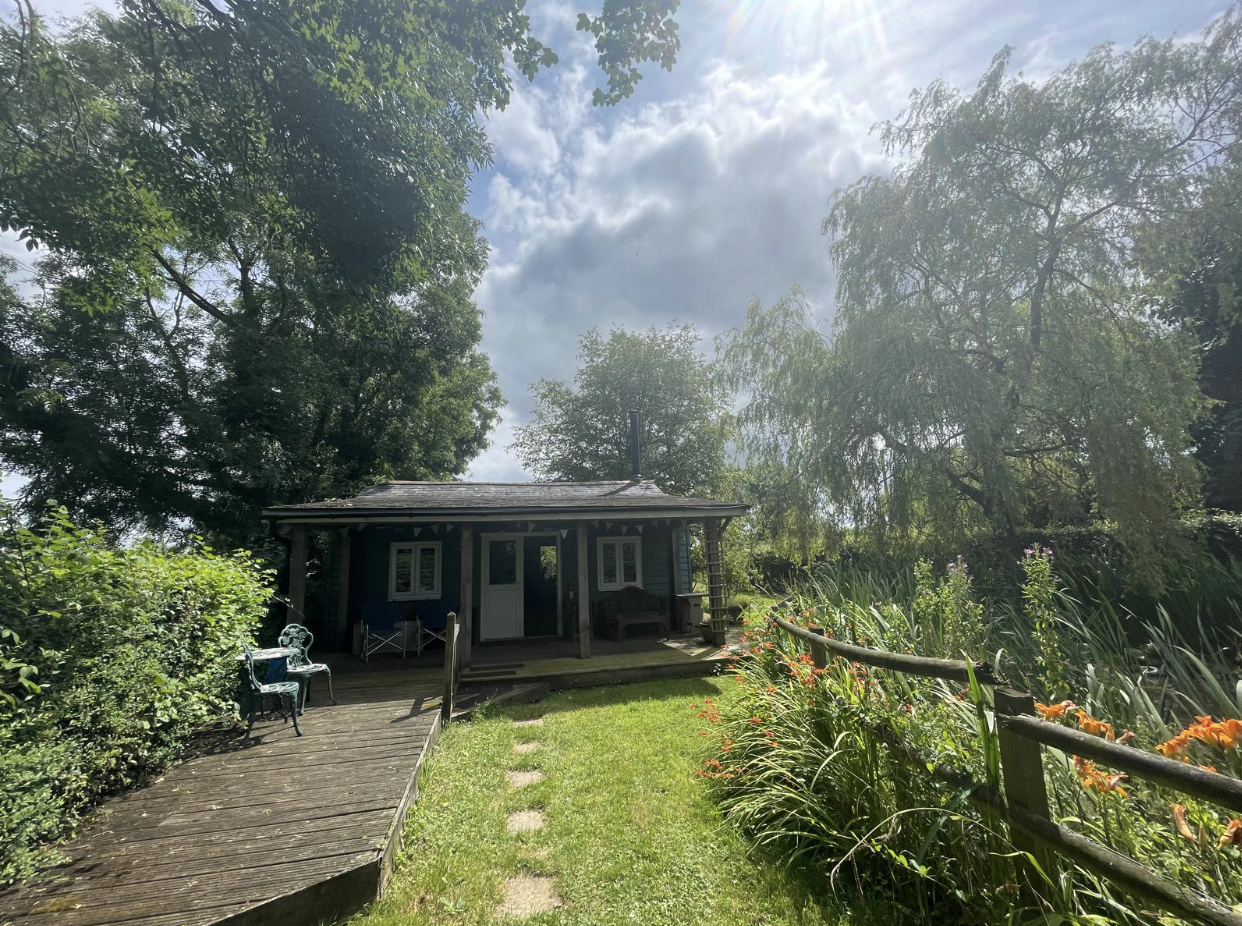
Nestled in a beautiful garden in Redlynch between Wincanton and Bruton is a quiet haven of colour, texture, and story - Lynne Davenport’s weaving room. With a lifetime of teaching, travelling, spinning, and weaving behind her, Lynne invited me in to talk about where it all began, and where the threads of her craft have taken her since.
“I always wanted to be a weaver.”
Lynne didn’t do any weaving herself until she was 18, when she started teacher training college in 1960 and took a textiles course specialising in spinning, weaving, and dyeing. But the seeds were planted earlier.
“My sister trained as an occupational therapist,” she explained. “In those days, weaving was a big part of OT. I think that’s where I first got the idea.”
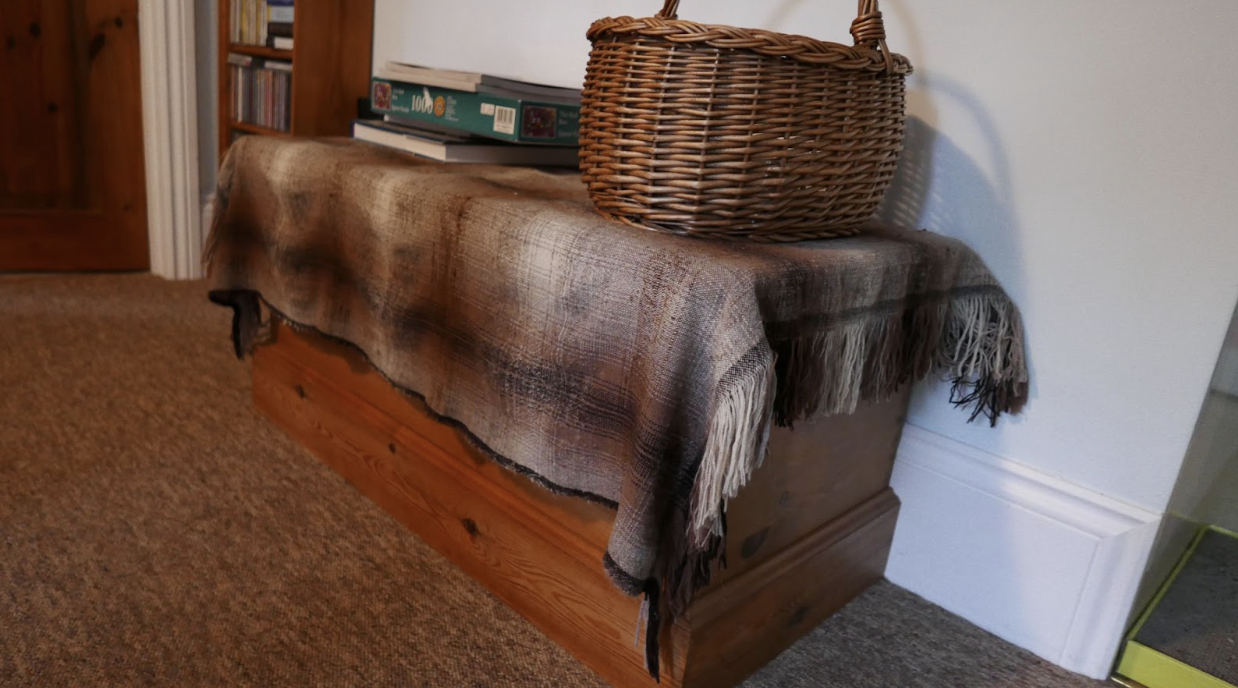
Sitting in her warm, light-filled room, she showed me her very first piece - a handspun weft blanket from 1961. “It’s pretty awful,” she laughed. “But I got better after that.”
Weaving with texture, teaching with care
Much of Lynne’s weaving journey has been shaped by her work with visually impaired children. “Colour didn’t mean so much to them, but texture did,” she said. “So I’ve always wanted to include texture in what I make.”
She trained to teach children with visual impairments and worked at a school in Sheffield, where she also got her first loom. “That experience really shaped how I think about tools,” she told me. “For example, I’m personally nto a fan of rigid heddle looms. If you’re working on a foot loom, you can beat with one hand and know it’s even. With a rigid heddle, you need both hands, and most people have a dominant hand, so it’s harder to keep things balanced.”
That sense of accessibility and shared learning runs through everything Lynne does, from volunteering at workshops for adults with learning disabilities, to running a Thursday group from her home, where she continues to share her skills.
“It’s not teaching,” she said. “It’s sharing and encouraging. We need more weavers.”
A life with the Guild
Lynne’s been active in many Guilds, including Hallamshire, London, Kent, Dorset and Somerset, often stepping into secretarial roles, organising, taking minutes, helping things tick along in the background. In Dorset, she was a secretary for nearly 30 years.
What’s the value of Guilds for her? “Oh, summer schools, the Journal, all the activities. I’ve even been to AGMs in Aberystwyth and London. I’ve always been keen and active.”
A world woven through textiles
Weaving has taken Lynne all over the world, to West and South Africa, Nepal, Iceland, Peru, and Japan. Nearly all her travels have had textiles at the centre.
“In Peru, I didn’t have a word of Spanish, and they had little English. But I brought photos of my loom, my workroom, and my weaving. Even if you can’t speak the language, that sharing brings you together. Craft is a universal language.”
She described visiting villages with a small group of fellow weavers, working with women while the local health visitor — the guide’s husband — ran clinics. “At one place, I remember seeing a drop spindle stuck in the thatch of a home. Just popped there for the moment. It was beautiful.”
“There are no mistakes. There is beauty in everything.”
One of Lynne’s memorable experiences was visiting a weaving organisation in Japan that worked with adults with disabilities. Their philosophy stuck with her: “There are no mistakes. There is beauty in everything.”
She’s carried that spirit through her weaving life, experimenting with different fibres, trying new techniques, and adapting to change. “I used to do rugs, but I haven’t got the strength now. Linen is hard these days, and silk’s tricky because it’s so fine. But I still love it.”
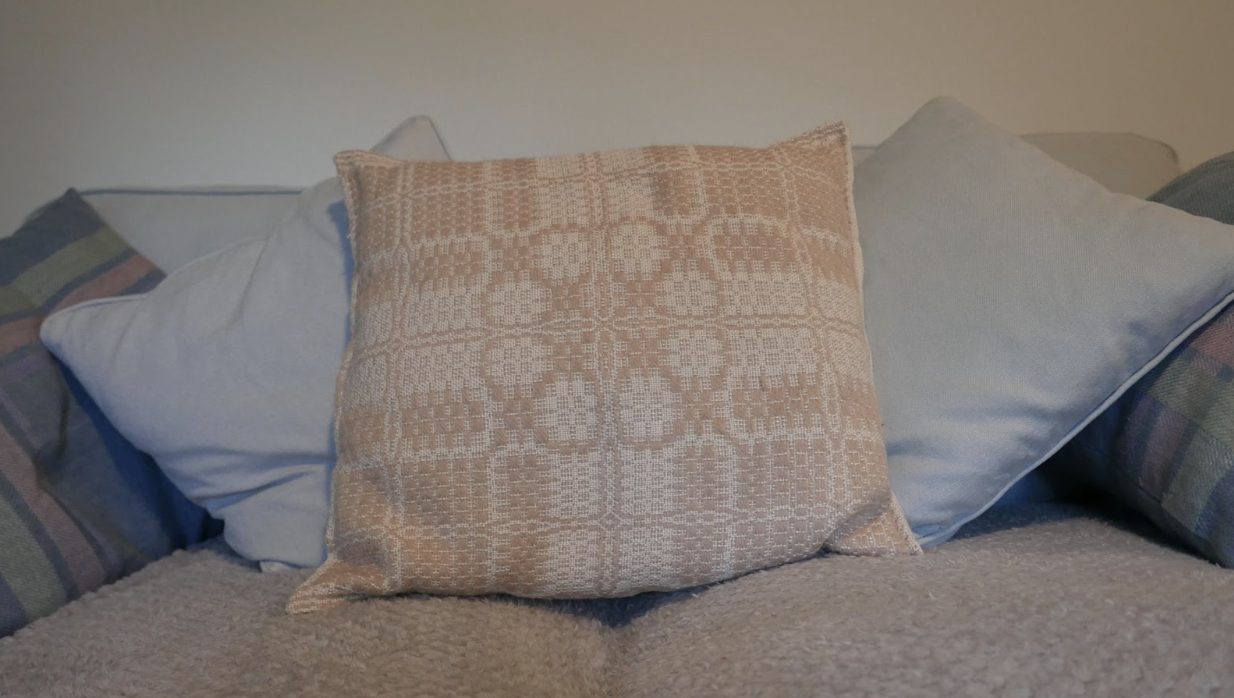
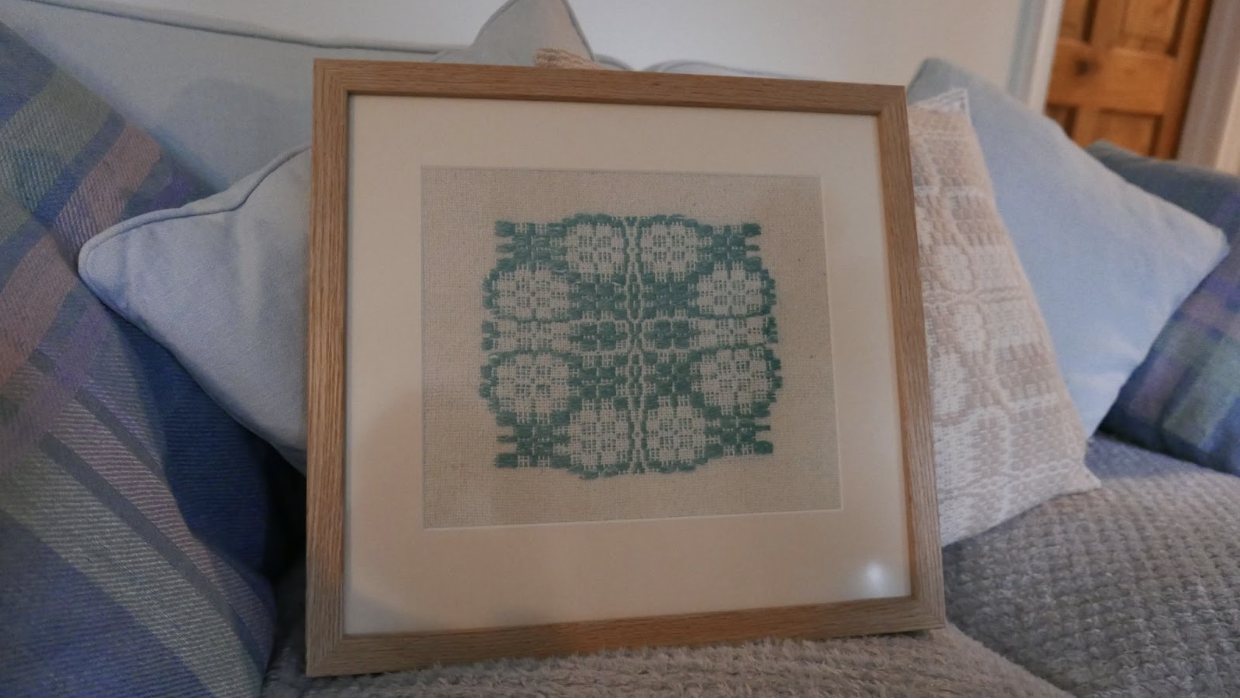
From wedding cushions to anniversary gifts, every piece has a story. She showed me two pieces, one woven for her daughter’s wedding, and a second created for their silver anniversary. “The first one had a mistake in it, so I used just the central motif for the second. I had to work out how to do it as a pick-up. That’s the framed one, you can include a photo of it.”
On looms, wheels, and spinning with friends
Lynne is a committed countermarch loom user. “You get a much better shed,” she explained. “With a counterbalance loom, one lot of threads rises and the other just flops. With a countermarch, you raise some and lower others, so it’s all working together.”
She also has a collection of spinning wheels, preferring the larger, sloping-bed types for a softer spin. “But spinning, for me, is mostly social. I never spin on my own. I spin mostly with friends.”
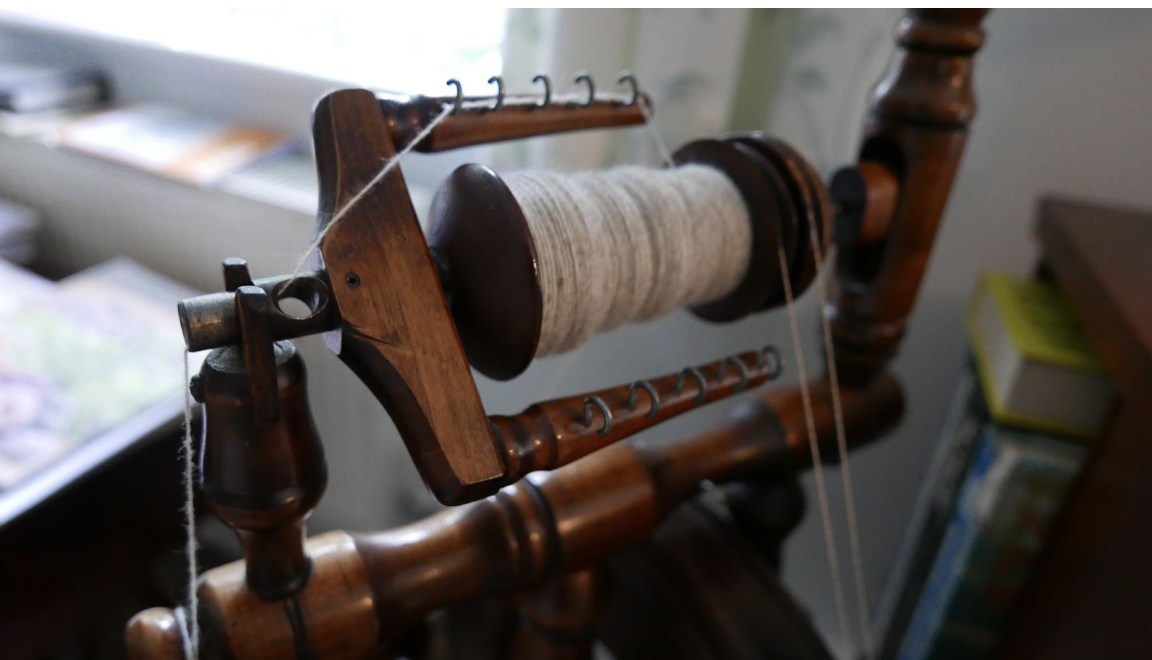
We talked about how spinning invites a certain kind of conversation. “Someone once said it’s like sitting round a campfire. The rhythm helps you open up.”

“We do need more weavers.”
As the interview wound down, Lynne reflected on what she hopes for the future.
“I hope people keep doing it. That young people are attracted, that they want to explore. There are so many new fibres and techniques now. I’m fairly traditional, but it’s wonderful seeing what people come up with.”
And has her family caught the weaving bug?
“Not quite, though my granddaughter Emily is already fussy about fabrics and what she wears. She’s definitely picked up the need to feel cloth, to study it closely. That makes me smile.”
Written by Laura Tyley